Showing posts with label scams. Show all posts

Tuesday, 5 April 2016

Scams - Romance and Dating Sites Part 2

Scams - Romance and Dating Sites Part 2
I have had people try and scam me, on a very personal level.  They say that scammers are very clever, but in fact they are very stupid.  They select their targets very carefully when they pull a scam.

They have tried many different scams on me.  They use the fact that I am single and alone, that I am lonely and crave love so badly. They strike up a relationship and their words soon turn to words of love.  For a desperate woman, this is all her dreams come true.  For me, I never believed a single word that was ever written.  Oh, the words of love, so passionate and enduring, one would think they should become writers instead of scammers!

I met this man on a dating site, he told me he was a business man and that he was away a lot and was hardly ever on this dating site and he suggest we exchange email addresses.

When I looked for him on this dating I site, I could not find him.  He had disappeared.  I never thought much of it.

He even gave me a cell phone number, and the dialling code was for the UK, again I never thought anything of this.

We even exchanged phone calls in the beginning.
He started sending emails on regular bases.  The relationship on his side moved very fast.  He was soon telling me how much he loves and misses me.

He even gave me a cell phone number, and the dialling code was for the UK, again I never thought anything of this.

I noticed in his emails that there were a lot of spelling mistakes and often he got my name wrong.  I replied to his emails and after a while I started to ignore his emails.  After a while I emailed him again and he just continues like nothing has even happened. He never got upset that I had been ignoring him!

The writer then continued in the same vain, words of love, how much he is missing me, how much he loves me and that he was in Italy and that he wanted me to send my physical address to him and he will send a small gift, a token of his love.  I did not use my own physical address, but the address where I work. 

He sent me another email, with the tracking number and the website address. I went to the website address that he provided me, but something was off.  The website looked very professional but something nagged at the back on mind.  I looked for contact details and I did not found any contact details.  Strange?  Also another thing the parcel was despatched very fast plus the status kept the same and never change.  I went to my boss with this; he is very familiar with scamming as his father in law was being scammed.  My boss showed me how to find the original web page that they had copied.  He went to that web page and underlined whole paragraphs and then went to Google and pasted it into the search engine.  Not long, he had found the real web page.

Once must be able to recognise a fake web page.

One of the first signs that something may be wrong with a website is an incorrect address. Always check the address bar and verify that all is as it should be.


The correct URL for Lloyds TSB is http://www.lloydstsb.com

The example above is a fake website

The next day I got a call from a black man, saying that my parcel had arrived and that I had to pay 5 thousands rand to get it released from customs, he said that he had sent an email with the banking details.
It’s virtually impossible for a package to arrive within 24 hours from the UK, they is much delays as the package makes it way from one depot to another before arriving at the airport.

In this package he had included money, in dollars, notebook and a few other things.  So it was claimed.  I know how customs work in this country and it does not work like that.

They would send an invoice from customs and payment would be done at the local post office, if a courier service was used, the courier company would get hold of me and send me an invoice, outlining the amount I need to pay and when delivery would be made on receipt of my payment.  All very official.
I knew I was being scammed, but how many others have fallen for this scam?


Another scam, I struck up with a conversation with this man, also from the same dating site.  He claimed that he was from West Africa.  We started to talk in Yahoo.  He said that he like me very much and would love to meet me soon.   He said he was prepared to fly all that way to come and visit me.  He wanted me to pay for half of his airfare.

I told him, sorry I don’t have the money to pay half of your airfare, but he persisted and was adamant that he had already had booked the tickets and he said he would send an email that he had received.

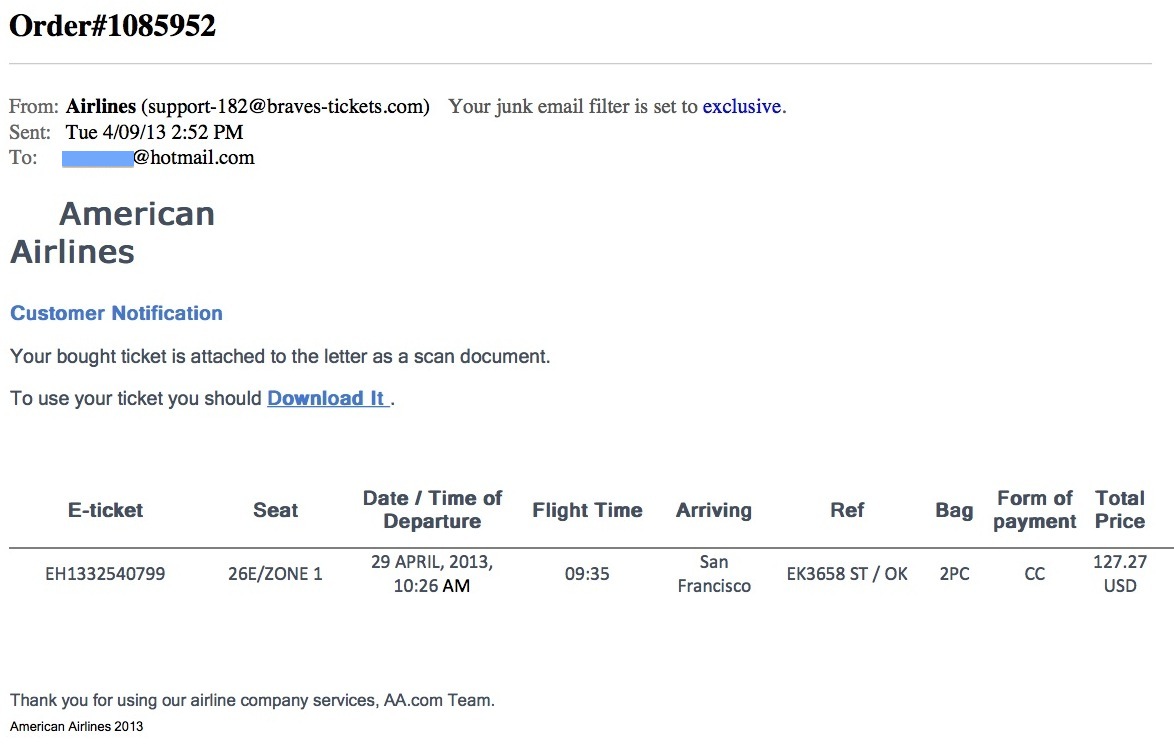
I received the email from South African Airways, with what appeared to be bookings that he had made.  It was a confirmation giving details on his departure.  I had already done some research on how much the airfare would cost, and the amount there was very high.  I did not take it as its face value and clicked on the link on the email. This link took me to a quotation page, on the South African Airways webpage.

This man had not booked his flight; instead he had edited the quotation that South African Airways had sent him, editing the price of ticket as well.

I looked it up on the internet, surprise, its a very common practice of scammers.

Fake Airline Confirmation Message

Just an example.

The Internet, a wealth of information, there are programs that can generate fake airline tickets.
Ticket-O-Matic

Scams - Romance and Dating Sites

Scams - Romance and Dating Sites

Scammers take advantage of people looking for romantic partners, often via dating websites, apps or social media by pretending to be respective companions. They play on emotional triggers to get you to provide money, gifts or personal details.  

They have even been known to telephone their victims as a first introduction. These scams are also known as ‘cat fishing’.

Scammers typically create fake online profiles designed to lure you in. They may use a fictional name, or falsely take on the identities of real, trusted people such as military personnel, aid workers or professionals working abroad.

Their profile on the internet dating website or their Facebook page is not consistent with what they tell you. For example, their profile picture looks different to their description of themselves, or they say they are university educated but their English is poor.

Dating and romance scammers will express strong emotions for you in a relatively short period of time, and will suggest you move the relationship away from the website to a more private channel, such as phone, email or instant messaging.

They often claim to be from a western country or another country, but they are travelling or working overseas.

Scammers will go to great lengths to gain your interest and trust, such as showering you with loving words, sharing ‘personal information’ and even sending you gifts. They may take months to build what may feel like the romance of a lifetime and may even pretend to book flights to visit you, but never actually come.

Once they have gained your trust and your defences are down, they will ask you (either subtly or directly) for money, gifts or you’re banking/credit card details. They may also ask you to send pictures or videos of yourself, possibly of an intimate nature.

Often the scammer will pretend to need the money for some sort of personal emergency. For example, they may claim to have a severely ill family member who requires immediate medical attention such as an expensive operation, or they may claim financial hardship due to an unfortunate run of bad luck such as a failed business or mugging in the street.  The scammer may also claim they want to travel to visit you, but cannot afford it unless you are able to lend them money to cover flights or other travel expenses.

Sometimes the scammer will send you valuable items such as laptop computers and mobile phones, and ask you to resend them somewhere. They will invent some reason why they need you to send the goods but this is just a way for them to cover up their criminal activity.  Alternatively they may ask you to buy the goods yourself and send them somewhere. You might even be asked to accept money into your bank account and then transfer it to someone else.

Warning - the above scenarios are very likely to be forms of money laundering which is a criminal offence. Never agree to transfer money for someone else.  Sometimes the scammer will tell you about a large amount of money or gold they need to transfer out of their country, and offer you a share of it. They will tell you they need your money to cover administrative fees or taxes.

Dating and romance scammers can also pose a risk to your personal safety as they are often part of international criminal networks. Scammers may attempt to lure their victims overseas, putting you in dangerous situations that can have tragic consequences.

Regardless of how you are scammed, you could end up losing a lot of money.  Online dating and romance scams cheat many out of millions every year.

The money you send to scammers is almost always impossible to recover and, in addition, you may feel long-lasting emotional betrayal at the hands of someone you thought loved you.

After gaining your trust – often waiting weeks, months or even years – they tell you an elaborate story and ask for money, gifts or your bank account/credit card details.

If you don’t send money straight away, their messages and calls become more   desperate, persistent or direct. If you do send money, they continue to ask you to send more.

They don’t keep their promises and always have an excuse for why they can't travel to meet you and why they always need more money.

Always consider the possibility that the approach may be a scam, particularly if the warning signs listed above appear. Try to remove the emotion from your decision making no matter how caring or persistent the ‘prospective partner’ is.

Do an image search of your admirer to help determine if they really are who they say they are? You can use image search services such as Google or TinEye.

Be alert to things like spelling and grammar mistakes, inconsistencies in   their stories and others signs that it’s a scam like their camera never working if you want to Skype each other.

Be cautious when sharing personal pictures or videos with prospective partners, especially if you have never met them before. Scammers are known to blackmail their targets using compromising material.

If you agree to meet a prospective partner in person, tell family and friends where you are going. It's strongly recommends you do not travel overseas to meet someone you have never met before. Be wary of requests for money. Never send money or give credit card details, online account details, or copies of important personal documents to anyone you don’t know or trust.

Avoid any arrangement with a stranger that asks for up-front payment via money order, wire transfer, international funds transfer, pre-loaded card or electronic currency. It is rare to recover money sent this way.

Do not agree to transfer money for someone else: money laundering is a criminal offence.

Be very careful about how much personal information you share on social network sites. Scammers can use your information and pictures to create a fake identity or to target you with a scam.

If you think you have been scammed, report it to the website, app, or social media site where the scammer first approached you. Let them know the scammer’s profile name and any other details that may help them to stop others being scammed.

If you think you have provided your account details to a scammer, contact your bank or financial institution immediately.

Please report scams, every country would have a web page for this.  This will helps so that others can be warned about current scams, monitor trends and disrupt scams where possible.


Spread the word to your friends and family to protect them.

Some web page address to report scams too

South Africa -  Scam Busters
Australia - Scam Watch
NETHERLANDS - Fraud Help Desk