Tuesday, 24 April 2018

South Africa - a bit about the country I live in


South Africa is divided into nine provinces. South Africa previously had four provinces from 1910. The following provinces were:-

  • The Cape of Good Hope
  • Orange Free State
  • Natal
  • Transvaal
 

In 1994 this was change to nine provinces, they are as follows:-
  • The Eastern Cape
  • The Free State
  • Gauteng
  • KwaZulu-Natal
  • Limpopo
  • Mpumalanga
  • The Northern Cape
  • North West
  • Western Cape


9 provinces of South Africa

Before 1994 there were 10 ethnically based homelands created for the black people of South Africa.  Four on them gained independence from South Africa but it is not recognised by any other countries in the world. 


Independent homelands


  • Bophuthatswana              -             independent from 06/02/1977                    Tswana
  • Ciskei                                  -             independent from 04/12/1981                    Xhosa
  • Venda                                 -             independent from 13/09/1979                    VhaVenda 

Non-independent homelands


  • Gazankulu                          -                                                                                         Shangaan
  • KaNgwane                         -                                                                                         Swazi
  • KwaNdebele                      -                                                                                         Ndebele
  • KwaZulu                              -                                                                                         Zulu
  • Lebowa                               -                                                                                         North Sotho
  • Qwaqwa                             -                                                                                         South Sotho 

homelands of South Africa
The apartheid regime tried hard to get the other six homelands to become independent, but these homelands were not interested.  These six homelands were ruled by South Africa.  To be independent meant that they could issues stamps and exchange ambassadors with South Africa as nowhere else recognised their independence in the world.  They had rights to vote in these areas but no rights to vote anywhere else in the country.  All the homelands had their own “legislative” assemblies and a limited amount of autonomy.  All the homelands had their own coat of arms and flags except KaNgwane which only had their flag and they used the South African flag.  In the homelands that were not independent they use both their own flags and the South African flag. 


All these homelands were reincorporated into South Africa from the 27th April 1994 and they no longer use the former symbols of their homelands. 


There are five countries that border South Africa, Namibia, Botswana, Zimbabwe, Swaziland and Mozambique. 


Lesotho and Swaziland are both enclaves of South Africa.  They are bordered on all sides by South Africa but remain autonomous countries.

 
enclaves - Lesotho and Swaziland

There are eleven official languages in South Africa

  • Afrikaans
  • English
  • IsiNdebele (Ndebele)
  • IsiXhosa (Xhosa)
  • IsiZulu (Zulu) 
  • Northern Sotho (Sepedi) 
  • Sesotho (Southern Sotho)
  • Setswana (Tswana)
  • SiSwati (Swati)
  • Tshivenda (Venda)
  • Xitsonga (Tsonga)


Non-official languages
  • Fanagalo 
  • IsiCamtho (Tsotsitaal)
  • Khoe, Nama and San
  • Lobedu
  • Northern Ndebele
  • Phuthi
  • Sign Language


The official flag of South Africa

The flag was designed by Fred Brownell who was a former South African State Herald.  The flag was first used on 27th April 1994. The design and colours present principal elements of the country's flag history.  The colour combination could have different many to the people so no universal symbolism can be attached to any of the colours. 

The central design of the flag, beginning at the flagpost in a "V" form and flowing into a single horizontal band to the outer edge of the fly, can be interpreted as the convergence of diverse elements within South African society, taking the road ahead in unity. The theme of convergence and unity ties in with the motto "Unity is Strength" of the previous South African Coat of Arms.

South African flat 27th April 1994

The Coat of Arms

The previous coat of arms was used from 1910 and was replaced with the present coat of arms on 27th April 2000 on Freedom Day,  the day of the year when the election first took place when the ANC were first elected into power.  The motto is written in the Khoisan language of the IXam people and it reads ǃke e: ǀxarra ǁke and it means "diverse people unite" which is a direct translation
South Africa's coat of arms 27th April 2000

The national bird of South Africa is the Blue Crane

The blue crane is on the critical endangered list.  The primary decline of this bird is due to human population growth and that grasslands are used for commercial tree plantation and deliberate poisoning in order to protect crops or accidental poisoning from poison meant for other species.  The blue crane is now under the protection of the South African government.  Research and educating the people have been implemented.


This bird is very special to the amaXhosa who have given the bird the name indwe.  The chief would award a feather from this bird to those who did deeds or valour.  The feathers would also be presented to the heroes after a battle.  These men were know as men of ugaba (trouble) and wore the feathers in their hair. When men were given this name, they had to step in when trouble arose and reinstate order and peace.
blue crane

The National fish of South Africa is the Galjoen

The galjoen is a species of marine fish and only found along the coast of South Africa.  It is found mostly in shallow water, and often found in rough surf.  It is well know to the angler because it can stay very close to shore.  Depend where they are found they look completely different in colour, near rocks they are completely back but when in sandy areas the colour is silver-bronze.  Another name or them is the blackfish or black beam.  They can grow to over 55cm and up to 7kg in weight.


Galjoen

National flower of South Africa is the King Protea

The King Protea, (Protea cynaroides), is a flowering plant. Its flower head (what the layman will call the 'flower') is the largest in the genus Protea: the species is also known as Giant Protea, Honeypot or King Sugar Bush. It is widely distributed in the south-western and southern parts of South Africa of the fynbos region.  The national cricket team of South Africa have the nickname Proteas.

king protea
The national cricket team of South Africa have the nickname Proteas.
emblem South African Cricket Team

The National animal of Sout Africa is the Springbox

The word in afrikaans, spring = jump, box = antelope, deer or goat.  Its a small brown and white gazella about 75cm high.  The males can weigh up to 50kg and the females around 37kg.  Both sexes have horns but the male horns are thicker and rougher.  These animals have adapted to the dry, barren areas and open grass plains.  they are most found in the Free State, North West province and the Karoo up to the west coast of South Africa. 


springbox


The national rugby team is nicked named the springbox.  They were also known as the Springbox in the apartheid era and they were supposed to be called the proteas when apartheid ended but the president at the time Nelson Mandela intervened and it was then allowed for the rugby team to keep their name.  The springbox emblem is also used for the South African Airforce and the South African coat of arms.  It was also used for a South African own car, the ranger in the early 1970's.

emblem South African Rugby Team

The National Tree of South Africa is the Real Yellowwood

This true has been around for more than a million years in South Africa.  The tree is widespread is found from the Table Mountain, along the southern and eastern Cape coats, and in the drakensberg up to the Soutpansberg and the Blouberg in Limpopo.  When they grow in a forest these tree can be up to 40 meters in height and the base of the trunk can be up to 3 meters wide.  But if they grown on unsheltered places, like mountain-slopes they are often short, busy and gnarled.  The colour of the bark is khaki-coloured to grey when its old and peels of in strips.  The male or female cones resembles the pine cones but are white, light green or pink.  The female cone has a fleshy pedocarpium and the seeds take on the shape and colour of a cherry.  The leaves are strap-shaped, 25-40mm long and mature trees about 100mm long and on young trees 5-12mm with a bluntly pointed tip.  It is a slow growing tree and the wood is hard.  The wood was used to make furniture, panelling, etc.  Little of these trees are cut now due to the fact of over-exploitation.

real yellowwood tree

National Athem

A proclamation issued by the then State President, Nelson Mandela, on 20 April 1994 in terms of the provisions of Section 248 (1) together with Section 2 of the Constitution of the Republic of South Africa, 1993 (Act 200 of 1993), stated that the Republic of South Africa would have two national anthems. They were Nkosi Sikelel' iAfrika and The Call of South Africa (Die Stem van Suid-Afrika). In terms of Section 4 of the Constitution of South Africa, 1996 (Act 108 of 1996), and following a proclamation in the Government Gazette No. 18341 (dated 10 October 1997), a shortened, combined version of Nkosi Sikelel' iAfrika and The Call of South Africa is now the national anthem of South Africa.

It is the only neo-modal national anthem in the world, by virtue of being the only one that starts in one key and finishes in another. The lyrics employ the five most populous of South Africa's eleven official languages - isiXhosa (first stanza, first two lines), isiZulu (first stanza, last two lines), seSotho (second stanza), Afrikaans (third stanza) and English (final stanza).

Lyrics

Nkosi sikelel' Afrika Maluphakanyisw' uphondo lwayo, Yizwa imithandazo yethu, Nkosi sikelela, thina lusapho lwayo. (Xhosa and Zulu)
Morena boloka setjhaba sa heso,
O fedise dintwa le matshwenyeho,
O se boloke, O se boloke setjhaba sa heso,
Setjhaba sa South Afrika - South Afrika.
(Sesotho)
Uit die blou van onse hemel,
Uit die diepte van ons see,
Oor ons ewige gebergtes,
Waar die kranse antwoord gee,
(Afrikaans)
Sounds the call to come together,
And united we shall stand,
Let us live and strive for freedom,
In South Africa our land.
(English)


The first people to settle in South Africa

The Khoi Khoi and the hunter gatherer San lived in Southern Africa about two thousands years ago and archaeologist have uncovered artwork and implements believed to be the oldest in the world
Today they are called the Khoisan, and were skilled hunter gatherers and nomadic farmers who lived of the land.  Even though they were here first, they are the most persecuted people even when apartheid fall in South Africa.  The Khoisan became the most forgotten.


Source : http://www.southafrica-newyork.net/consulate/anthem.html

http://mediaclub.co.za/landstatic/163-provinces_new

https://theculturetrip.com/africa/south-africa/articles/what-to-know-about-the-khoisan-   south-africas-first-people/


Friday, 20 April 2018

Ligers, hybrid of the male lion and female tiger


Ligers - Panthera Leo × Panthera Tigris (no scientific name and they are a hybrid)


Ligers are a result of cross breeding between a male lion and a female tiger.  They are not found in the wild.  The male lion and the female tiger would not breed in the wild, as they more likely fight to defend themselves and in they would avoid each other to protect themselves.

ligers (cross between male lion and female tiger)


Ligers can live with both lions and tigers.  The liger is a social animal.  Ligers have the head of the lion and the body of a tiger.  When they are breed together it enhances both species genes?  They about 11 feet tall and weigh about half a ton (500 kilograms).  The liger shares traits both from the lion and the tiger but the traits inherited from the lion is more.  They have a muscular body and their fur is sandy or dark yellow and there are distinctive faint stripes, which is inherited from the mother.  Other colour is white which comes from a white tiger.  The male liger can have a mane like the lion but it is not as impressive as the male adult lion.  Sometimes there is no mane on the liger male.  The stripes are more noticeable on their hind quarters.  The liger can also inherit the spots found on the back of the tiger’s ears along with the tufted fur around their chins.  The liger has very strong and large jaws with sharp pointed teeth that are used for tearing through flesh.  The sharp claws also help them to catch prey.


If the ligers were to be found in the wild they would be a dominant predator and the only thing that would be a threat to them is HUMANS, but they are not find in the wild and the place where they are found are in zoos who keep them only in order to make money.

liger kept in capitivity - zoo

Ligers were breed in the 19th century when a litter of cubs were born in Asia 1824.  No other litters were recorded until 100 years later in a zoo in South Africa (the bastards!).  The ligers have no conservation status and they never bred in the wild.  The ligers have no value to conservationist.  Thank God there are some countries in the world that have banded the breeding of these ligers.


One of the traits that the liger shares with the tiger is the love of swimming though it might take them time to venture into the water as the male lion does not like water.  A liger can run at the speed of 50 mph (80kmh).  The roar of the liger can either sound like that of the lion or the tiger, depending on the given situation at the time.  Being hybrids they can have shorter lives as they are prone to cancer and other diseases.

If the ligers were to be found in the wild they would be a dominant predator and the only thing that would be a threat to them is HUMANS, but they are not find in the wild and the place where they are found are in zoos who keep them only in order to make money.

Ligers were breed in the 19th century when a litter of cubs were born in Asia 1824.  No other litters were recorded until 100 years later in a zoo in South Africa (the bastards!).  The ligers have no conservation status and they never bred in the wild.  The ligers have no value to conservationist.  Thank God there are some countries in the world that have banded the breeding of these ligers. 

One of the traits that the liger shares with the tiger is the love of swimming though it might take them time to venture into the water as the male lion does not like water.  A liger can run at the speed of 50 mph (80kmh).  The roar of the liger can either sound like that of the lion or the tiger, depending on the given situation at the time.  Being hybrids they can have shorter lives as they are prone to cancer and other diseases.

liger with it human pet
The gestation period is a 100 days.  The tigress of liger cubs might need to have a C-section as the liger cubs is big when they are born.  They can give before from 2 to 4 cubs.  The cubes eyes are not open and they are totally depended on the mother until they reach the age of 6 months. 


The liger cubs grow very fast.  The cubs weight 1.5 kilogram at birth and can put on as much as half a kilogram per day.  By the end of their first year that could weigh 165 kilograms and by the time they reach 3 years old as much as 320 kilograms.  The liger’s cubs have darker spots on their fur and these spots can remain when the liger reaches maturity, especially on their undersides.  Sadly many of the liger cubs are born with birth defects and they don’t survive for more than a week.

 
liger cubs

When the cubs mature it’s unlikely they can breed as more than often they are sterile with each other.  The female liger would have to be breed with a lion or a tiger.  The resulting cubs would either be called a li-liger or a ti-liger depending on the father.


Thursday, 19 April 2018

Tigers - Panthera Tigris


The tiger had nine subspecies.  Three of these are extinct and the other six are on the critically endangered or endangered list according the IUCN (Union for the Conservation of Nature) Red List.  Tigers are the world’s largest cat.


1.       The Sumatran Tiger – Panthera Tigris Sumatrae


The name of the tiger is due to the fact that these tigers can only be found on the Indonesian island of Sumatra.  According the U.S. Fish and Wildlife Services, there are between 500 to 400 tigers left.  The Sumatran is the smallest of the remanding subspecies of tigers.  This tiger is on the critical endangered list.  The tiger has the darkest coat, and the black stipes are broad and closely spaced and even doubled.  It also has striped forelegs.  Most of the remaining tigers now live in five national parks, two game reserves and about 100 live in unprotected areas that most likely will be lost to agriculture in the future.  This is the greatest threat to these tigers, followed by poaching.  It is illegal to hunt the tiger but this does not stop them.  China is a large consumer of tiger parts, as well as Taiwan and South Korea and even in some North American cities.

Most of the remaining Sumatran tigers now live in five National Parks, two Game Reserves, though around 100 live in an unprotected area that will most likely be lost to agriculture in the near future.
Sumatra Tiger


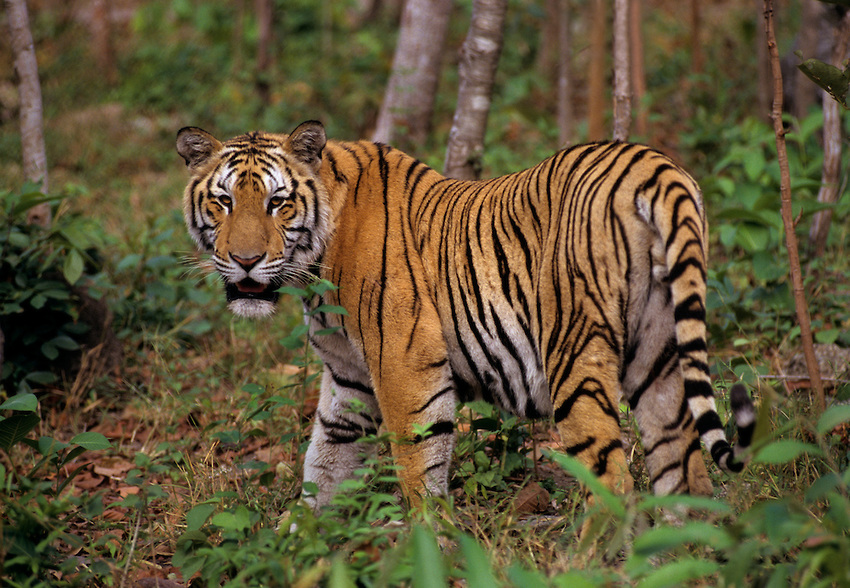
2.      The Bengal Tiger – Panthera Tigris Tigris


This tiger is found in India and Bangladesh and also in Nepal, Bhutan and Burma.  They are also called the Royal Bengal Tiger.  They are the most common subspecies of the tiger and are the second largest of the remanding subspecies of tigers.  There orange coat can black or brown stripes.  Each cat has their own unique striping patterns.

Bengal tigers hunt medium and large sized animals, wild boar, badges and water buffaloes.  Their prey can also be small elephants and rhino calves.  The tiger can drag prey 5 times their own body weight.  The tiger hunts mostly at night, and they kill their prey by severing the spinal cord or by inflicting a suffocation bite, which is generally done on larger prey.  Habit loss and poaching are threats to the survival of this tiger.  They are not only killed for their skin but for their body parts which is used to make traditional Asian medicines.
Bengal Tiger


White Bengal Tiger has a striking white coat.  This is caused by a double recessive allele in its genetic makeup and this only occurs once in every 10,000 births.
White Bengal Tigers


3.      The Indochinese Tiger – Panthera Tigris Corbetti


            This tiger is found in Cambodia, Laos, Burma and Thailand.  They are also called
            the Corbett’sTiger.  They have the darker shade of orange than any other subspecies of
            tigers.  The stripes act to help camouflage the tigers from their prey.  There are an estimated
            number of 1500 of these tigers left in the wild but because the tiger has a wide range some
            scientist believe that there could be only as few as 1200 left in the wild.  The tiger diet consist
            most of wild pig, wild cattle and wild deer.  The male tiger is about 8 to 9.5 feet long (2.43 to
            2.89 meters) and females are 7 to 8.5 feet long (2.13 to 2.5 meters).  The male weigh from
            330 to about 430 pounds (149 to 195 kilograms).  Habit close is also a bit concern, plus
            poaching.  Use of body parts in traditional medicines also put this tiger at risk.
Indochinese Tiger


4.        The Malayan Tiger – Panthera Tigris Jacksoni


               This tiger is a separate subspecies of the Indochinese tiger.  The Malayan tiger is very
               similar to the Indochinese tiger but it is smaller in size.  They are found exclusively the in the

               Subtropical forest in the southern tip of Thailand, and the peninsular Malaysia in
               South East Asia.

 
Malayan Tiger


5        The Siberian Tiger – Panthera Tigris Altaica


They are the largest of the subspecies of tiger.  They are also called amur tiger.  There are about 350 to 450 in the wild.  They are     found in the Primosky and Khabarovski Krais areas of the Russian Far East, with a smaller population of about 35 individuals are found in the areas of the Russian Far East.

The tiger does not have strips on its forelegs like the sumatran tiger.  The tiger can weigh up to 660 pounds (300 kilograms).  The males can grow up to more than 10.5 feet (3.3 meters) from head to tail.  The same threats exist for these tigers, habit loss, poaching and body parts used for medicinal purpose.
Saberian Tiger


The cross between the Bengal and Siberian tiger has a paler orange fur than other tiger subspecies.  They have brown stipes instead of black stripes.  The fur is much thicker than that of any other tigers living in southern Asia to help them with the cold winters.
cross between the bental and siberian tale is paler orange (right)


6.      South China Tiger – Panthera Tigris Amoyensis


             These tigers are found in central and eastern China.  In 1970’s these tigers were
             considered as pest by the Chinese government and hunted to the brink of extinction.  They
             are on the critical endangered list and are nearly extinct.  There are about 47 tigers living in
             18 zoos in China.  There are no tigers left in the wild.  The tiger has a yellowish fur with 
             narrower and longer stripes than those of the Bengal tiger.  The male is bigger than the  
             female and is between 7.58 to 8.666 feet (2.310 to 2.64 meters) long.  The female is 7.25
             to 7.83 feet (2.21 to 2.38 meters) long.  The male weighs 287 to 386 pounds (130 to
             175 kilograms).  The female weighs 243 to 254 pounds (110 to 115 kilograms).  The tiger
             was known to attack man and cattle for invading its natural habitat.  The tiger could
             consume between 39 to 88 pounds in a single setting (18 to 40 kilograms).   The male
             tiger does not  mix with the female tigers, only when it is in the breeding season.  The tiger
             reaches maturity between 3 to 6 years.  The gestation period is 103 days.  The female tiger
             can deliver up to 7 cubs but the usual is 2 or 3 only.  The mother breast feed their cubs for 8 
             months and at the age of 2 months they start eating solid food and leave the den.   
             Between the age of 18 and 36 months, they are ready to hunt and become independent.

The future for these tigers does not look promising and it looks like they will be the next tiger to become extinct. Attempts are being made with breeding programs and so far they have been successful but a lot of work still needs to be done.

 
south china tiger


Extinct Tigers


1.        The Bali Tiger – Panthera Tigris Balica.


               This tiger used to be found only on the Bali Island in Indonesia.  It was the smallest tiger of 
               the tiger subspecies. The females could weigh as little as 14 pounds (75 kilograms) and
               the males could reach around 200 to 220 pounds (90 to 100 kilograms).  The Bali tiger
               reached extinction through hunting.  Bali tigers had darker, shorter fur than any other t
               tiger subspecies.  The tiger had a bar-shaped pattern on its head.  They had a lifespan
               roughly of 8 to 10 years in the wild.

 
bali tiger


2.        The Caspian Tiger – Panthera Tigris Virgata.


               This tiger was caller the Hyrcanian Tiger, Persian Tiger and even the Turan Tiger.  These
               tigers was lived around the Caspian Sea, through Turkey, Iran and Central Asia to the
               the Chinese desert of Xinjiang.  They were some of the biggest of the tiger subspecies, 
               together with the Bengal tiger.  Males usually exceeded 6.56 feet (2 meters) in length. 
               The tiger had a brighter golden coat, with brown-gold stripes.  In winter the coat would
               become less bright and the pattern would not be so pronounced.  The stripes were  
               narrower and closer together than any of the other tiger subspecies.  When the Russians 
               came to Turkey in the late 1800s, they hunted the Caspian Tiger.   They also hunted the 
               natural prey of the tiger so many of the tigers would die from starvation.  In the 1990s it 
               was believed the last of these tigers died, but nobody seemed to have interest in those
               days, so it was never investigated or confirmed.

 
caspian tiger


3        The Java Tiger – Panthera Tigris Sondaica


These tigers were found exclusively on the island of Java.  The male tigers were very small, about 250 pounds (115 kilograms) and the females were even smaller.  Their noses were         long and narrow.  Their stripes were also narrow.

 In 1947 these tigers were protected but it came too late.  It was in the 1970s that this tiger came extinct.  It was believed that the tigers were poisoned by the locals who wanted to protect themselves, and of cause hunted for financial gains.  They also faced starvation and their prey was being killed to the point of extinction.

java tiger