Wednesday, 18 April 2018

Banana Plants


Bananas have been in our diet for many years and there are references going back to around 500BC.

100 billion bananas are eating around the world and 51% of these are eaten at breakfast.  Bananas are the most popular fruit in the world.  Some horticulturists believe that the banana was the first fruit on earth.  There are 1000 different varieties of banana growing around the world which is subdivided into 50 groups.  The Cavendish banana is the most common banana that is exported worldwide. 
leaves of banana plant


The banana plant is a large perennial herb with leaf sheaths that form trunk-like pseudostems.  The plant has 8 to 12 leaves that can grow to 9 feet long 2 feet wide. 

root system of banana plant

The development of roots in loose soil can be up to 30 feet laterally.
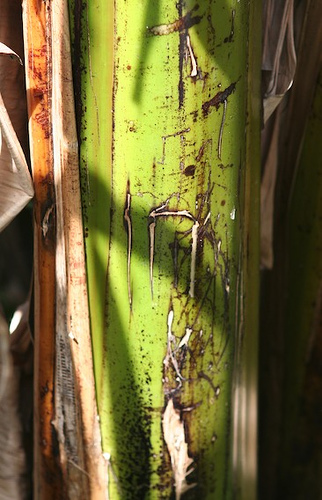

pseudostem


The pseudostems is the part of the banana plant that looks like a trunk. It is formed by the tightly packed overlapping leaf sheaths.  .  Each pseudostem produces only one banana cluster before dying.  New stalks are produced from the rhizome so the plants will continue to make more bananas for several years. 


rhizome


Rhizome, horizontal underground plant stem that is capable of producing the shoot and root systems of a new plant. Rhizomes store starches and proteins and enable plants to survive underground during unfavourable seasons.

the inflorescence


The Flower first appears on the mother tree, the first tree roughly 9 to 12 months after first planting.


The inflorescence (flower stalk) grows through the centre of the pseudostems. Flowers develop in clusters and spiral around the main axis. In most cultivars, the female flowers are followed by a few "hands" of neuter flowers that have aborted ovaries and stamens. The neuter flowers are followed at the terminal ends by male flowers enclosed in bracts. The male flowers have functional stamens  but aborted ovaries.


Fruits mature in about 60 - 90 days after flowers first appear. Each bunch of fruits consists of variable numbers of "hands" along a central stem. Each "hand" consists of two transverse rows of fruits ("fingers").


The fruit quality is determined by size (finger length and thickness), evenness of ripening, freedom from blemishes and defects, and the arrangement of the clusters.


Mature bananas are 2.5 to 12 inches in length and 0.75 to inches in width.  Banana peels can be red, yellow, or green or another colour depending on the type of banana plan.  The flesh of the banana can be white to yellow in colour.  The texture of the banana is firm and gradually turns tenderer as it ripens.

The yellow banana is called Cavendish banana and originated from China and Vietnam.  This banana was named after the man who obtained the specimen of this plant., the sixth Duke of Devonshire, William Cavendish.  Other names for this banana is canary banana and Chinese banana.


Red bananas are smaller in size than a common banana and the peel is a deep red or purple. It has a creamy white to pink flesh, with a slight raspberry-banana flavour. The overall taste is similar to a common yellow banana. They are imported from Costa Rica and are a favourite in Central America.

Blue Java Banana are blue in colour.  They have large burgundy flowers that make the trio of colours.


Its a beautiful tree and must be seen to believe.


Pink velvet bananas measure 3 inches long and they have seeds.  The plant grows 6 feet in height and flowers just after a year.  This banana is eatable.  The banana is sweet tasting.  When the banana is ripe it peels itself.


The purple banana plant is an ornamental plant.


Some Interesting facts about bananas

  • The scientific name for banana is 'musa sapientum' which translates as 'fruit of the wise man'
  • The word banana comes from the Arabic word "banan", meaning finger
  • The banana plant is not a tree, it is the world's largest herb
  • The "trunk" of a banana plant is not made of wood, it is made of tightly overlapping leaves
  • Bananas could help you to feel happier, as they contain tryptophan, a type of protein that the body converts into serotonin, known to promote relaxation and improve mood
  • The inside of a banana skin can be used to calm an itchy mosquito bite - many people find that rubbing the bite with the skin helps to reduce irritation
  • A medium-sized banana contains only 95 calories, and provides a quick-but-sustained energy boost in a natural, nutritious and easily digestible form with no fat, cholesterol or sodium
  • British Banana supplier, Fyffes, received its first consignment of bananas 124 years ago, in September 1888
  • A stem of bananas consists of “hands”, which consist of 10 to 20 bananas.  When a hand is split, the bananas become “clusters”, which generally consist of between three to eight bananas
  • The inside of a banana skin can be used to polish shoes!


Tuesday, 17 April 2018

For a flatter stomach and a much healthier life


A good posture will help, straighten the spine and your will automatically use the stomach muscles and tone them at the same time.  Do exercises to help strengthen the back muscles.


Drink a lot of water, about 8 cups a day.  Dehydration also affects your ability to think and to remember things.  Stay away from cold drinks with sugar in it.  Dehydration also makes you hoard water making you carry excess weight around your middle.


Eat a lot of fruit or vegetables.  Start you meal of with a salad, or a soup.


Snack on nuts but avoid the salty nuts.  Nuts are rich in monounsaturated fats.  Nuts can lower cholesterol.


Caffeinated coffee is also beneficial.  As coffee is a natural diuretic it helps with regular bowl movement and this too makes one stomach flatter.  Coffee also helps to eliminates excess water in the body.


Green tea is also good for you, for a number of reasons.  Green tea increases your metabolism rate.  Green tea also helps with cholesterol and reduces it.  Green tea helps regulate the rise of blood sugar after eating preventing high insulin spikes which then will prevent fat storage.  Theanine is an amino acid, found in the tea, gives a tranquil and relaxing effect and is beneficial to the drinker. 


Green tea has catechins.  Catechins are strong antibacterial and antiviral agents, used for treating flue to even cancer.  Green tea can help prevent tooth decay as well.  Green tea also helps wrinkles and the signs of aging.  Green tea has antioxidants as well as anti-inflammatory properties.  Regular drink of green tea can prevent high blood pressure.


Eat your meals slowly.  Chew your food properly.  The body has to work hard to break down the food in the stomach and intestines.  Eating food fast can cause gas and indigestion.


Introduce pro-biotic into your diet, they are good bacteria.  Pro-biotic helps to break down the food in your stomach.  Have yoghurt with your cereal rather than milk.  People on antibiotics should also eat yoghurt as it helps line the stomach, therefore protecting the lining of your stomach. 


Dairy products are loaded with calcium, a mineral that may be nature method of fat reducing.  A diet high in calcium can suppress the cortisol that can enlarge fat cells and increase your fat storage.  Your need to get your daily recommended amount of 1000 milligrams in order to make your body break down the fat more effectively.


Walking helps boost the metabolism.   It’s simple and will burn fat around the middle.


Take 20 minutes a day just to relax.  When you are tired your body produces more steroids and stress hormones which can affect your digestive system negatively and that cause major constipation.  Cortisol production also increases.  Cortisol is a “fight or flight” hormone that sends fat directly to your midsection in order to protect vital organs.


Snacks every three to four hours helps prevents you from over doing it when you do eat.  It also helps with regulate the metabolism rate in your body.  Starving or not eating correctly is not the answers, as when you do eat, everything seems to head for the hips.  It’s the body’s way of storing up food.


Make sure that you have the recommended seven hours of sleep.  Lack of sleep also slows down metabolism rate in the body.


Eat a well balance breakfast in the morning.  You will eat less during the day than those that skip
breakfast in the morning.  Eating breakfast in the mornings will help you cope with the day to come.

Children that go to school on an empty stomach have a harder time concentrating and learning. 


Include sea food in your diet which includes fish.  Fish has lower calories than compared to red meats.  Fish has omega-3 fatty acids which turn on the fat burning process providing that you take a walk daily.


Use spices and herbs to flavour your dishes, instead of oil, butter and cream.  Chile peppers can be a powerful appetite suppressant, metabolism booster and fat burner.


Eat whole wheat brown bread.  Whole wheat is digested slowly so can control your blood sugar levels better.  White bread is refined and may cause to worse constipation.  Whereas whole wheat brown bread with assist in regular bowl movements. Keep away from refined foods.

 
Substitute foods for another.  Take for example spaghetti.  Normal spaghetti has no nutritional value.  Use squash spaghetti.  It’s easy to cook and low in carbohydrates and calories and very nutritional for you.  It has a good source of calcium, potassium, magnesium and niacin.


Gluten-free flour for normal wheat flour.  Your will lose the stickiness that helps combined the ingredients so you would need to use 1 teaspoon xanthan gum per cup of flour.


Couscous is made from processed wheat flour so substitute it for quinoa.  Quinoa is a whole grain superfood packed with proteins and nutrients and has almost the same texture as couscous.  You can even substitute oats for quinoa.  Cooked in whatever milk (cow’s, coconut, almond) one has available with some cinnamon can make a very tasty and nutritional breakfast.


Substitute flour tortilla with corn tortilla.


Use nuts instead of croutons to give your salad that extra crunch.


Use unsweetened apple sauce for sugar.  Just remember to reduce the amount of liquid by the amount of apple sauce used.


Use natural peanut butter instead of reduced-fat peanut butter as they are inclined to put a lot more sugar and preservatives into it.


Instead of sugary drinks, use sparkling water with a few slices or lemon or oranges to give it the flavour.


Use stevia for sugar.  It’s an artificial sweetener that is 300 times sweeter than sugar.  Get the ratio right.  One cup sugar can be replaced with about 2 tablespoons stevia powder.  You can even replace sugar with vanilla essence.  Cut down 2 teaspoon sugar with half a teaspoon of sugar.


Replace cacao nibs with chocolate chips as you cutting out the sugar and preservatives.


Sprinkle cinnamon on your coffee instead of cream.  It gives your coffee a pleasant taste.


Pre-flavoured yoghurt has lots of sugar.  Use plain yoghurt and mix your own fruit selection in it.  Add honey if you want a bit of sweetness in it.


Drink a glass of red wine rather than white as it has health benefits including cancer fighting compounds and cholesterol checks.


Use sweet potatoes instead of normal potatoes.  Sweet potatoes has extra fibre, vitamins A,C and B6.  It also cuts 20grams per 1 cup servings.


Eat popcorn rather than potato chips.  Its low in fat and you can add your own flavouring on the popcorn.


Cook brown rice rather than white rice.  Brown rice has more fibre and nutrients.


Used avocado smash instead of mayonnaise on sandwiches as it is full of healthy fat or use some Greek yoghurt and add lemon for taste.  You will not even notice the difference.


Rather oven cook chicken pieces and grill steaks. This is much healthier.


Thursday, 12 April 2018

Polar Bear Cubs in capitivity

The first polar bear cub to be born after 25 years is in the United Kingdom in Scotland, at the Highlands Wild Life Park.  The first sounds from the cub(s) could be heard on 18 December 2017.
The mother is called Victoria.  Victoria's maternity unit has been closed to ensure her privacy from the visitors.    The keepers are trying to disturb the mother and cub as little as possible.  They make routine checks to see that the water outside the den is not frozen. They are not certain if there is one or two cubs as the video camera in the den was dislodged by Victoria.  The only way the keepers are checking is by using external audio equipment in the den.
 
 
There is only one cub.  This is a video of the cub taking outside the den.  They don't know with its a female or male.


Victoria came from Aalborg Zoo in Denmark in 2017 and is kept in an enclosure about a mile away from the other two males, Arktos and Walker.  She last had cubs in 2008.


The polar bear is polygynous, the female mates with more than one male, therefore the cubs can all have different fathers.


The gestation period for a polar bear is around 6 months. The female has to put on 440 pounds so she can survive being in the den without food for around three months.  Polar bears give birth once every three years. New born polar bears cubs eyes are closed when born and their weight is a little more than a guinea pig.  The cubs weigh about 2 pounds. At a month old their eyes open. Scientist are baffled by the fact that the cubs are born so tiny. They depend entirely on their mother and the fat-rich milk they get from her.  The cubs grow very quickly.  The cubs are around 3 months old when they emerged from the den and by that time they weight 22 to 26 pounds.  Survival rate of the cubs are very low for the first three months of their lives.


This birth came after 24 hours of the news that a polar bear cub died at a zoo in Berlin at the age of 26 days.  This cub's mother was called Tonja.  The cub seemed to have died of natural causes.  In march 2017 Tonja cub that was 4 months old at the time of death.  There is no reasons that they could find out why this cub died.  The cub died before they could name her.


Nora the polar bear cub was born on the 5th of November 2015.  The mother left the den when Nora was 6 days old and never return.  This was at a zoo in Columbia.  The zoo keepers decided to hand rear her.  The video below is a video of Nora. Nora is “a combination of the cub’s parents’ names, Nanuq, and Aurora.  They took keep the male polar bear in the same enclosure as this stresses out the mother and he could kill the cub.


Brumas was a polar bear born November 1919 in United Kingdom and raised successfully.  She was a female but for a long time they thought she was a male.  She died in May 1958.

Pipaluk, a male polar bear, was the first male polar bear born in captivity in Britain, and, like Brumas, became a major celebrity at Regent's Park Zoo in London during early 1968. His name came from an Inuit term meaning "little one". Pipaluk was moved from London to Poland in 1985 when the Mappin Terraces, which housed the bears, was closed. He died in 1990.


The next cubs were Millie and Jason. They came into the world to a similar fanfare at Flamingo Land, North Yorkshire, in 1992. Aged 18 months, they were wrenched from their mother, sedated and dispatched to a fate unknown at a Japanese zoo.

Knut and his twin were also abandoned by their mother in a Berlin Zoo.  Unfortunately Knut's twin brother died.  Knut became a global star and was reared by Thomas

Dörflein.  Knut later died at the age of four.  Knut was the first cub that survived infancy in a Berlin Zoo for more than 30 years.  Knut died on 19 march 2011, after accidentally falling into the enclosure pool while he suffered encephalitis.


Around about that time there was another two in a British public zoo.  A male called Barney and a female called Mercedes.  Barney died in 1996 after he chocked on a plastic bat that was thrown into his pen at the Edinburgh zoo.
Gus, a male polar bear at the Central Park Zoo in New York City from 1988 to 2013, came to media attention in the 1990s when he was seen obsessively swimming in his pool for up to 12 hours a day. The zoo paid an animal behavioural therapist to diagnose Gus' problem;[the therapist concluded that Gus was "bored and mildly crazy in the way that a lot of people are in New York".  Gus' erratic behaviour tapered off with changes to his habitat and mealtimes; he was also the first zoo animal in history to be treated with Prozac. From the publicity surrounding his diagnosis and treatment, Gus became a symbol of the "neurotic" New Yorker and was the subject of several books and a play.
Binky was a male polar bear at the Alaska Zoo who mauled several zoo visitors after disregard safety bars and signs and got to close in 1994.
Flocke was a female polar bear, born in Nuremberg Zoo, Germany on 11 December 2007.  She was raised by hand.


Inuka a male polar bear was born in a Singapore Zoo in 1990.

Siku, a male polar bear, was born in November 2011. Abandoned by his mother, who produced insufficient milk to feed him, he was put into care at Skandinavisk Dyrepark (the Scandinavian Wildlife Park, Denmark).

Wilbär, a male polar bear, was born at the Wilhelma Zoo in Stuttgart, Germany in 2007.


In 2003, Oxford University biologists found that infant mortality for captive polar bears was around 65%. Those that survived spent a quarter of their day engaged in the kind of pacing that any layperson realises betrays a disturbed beast.